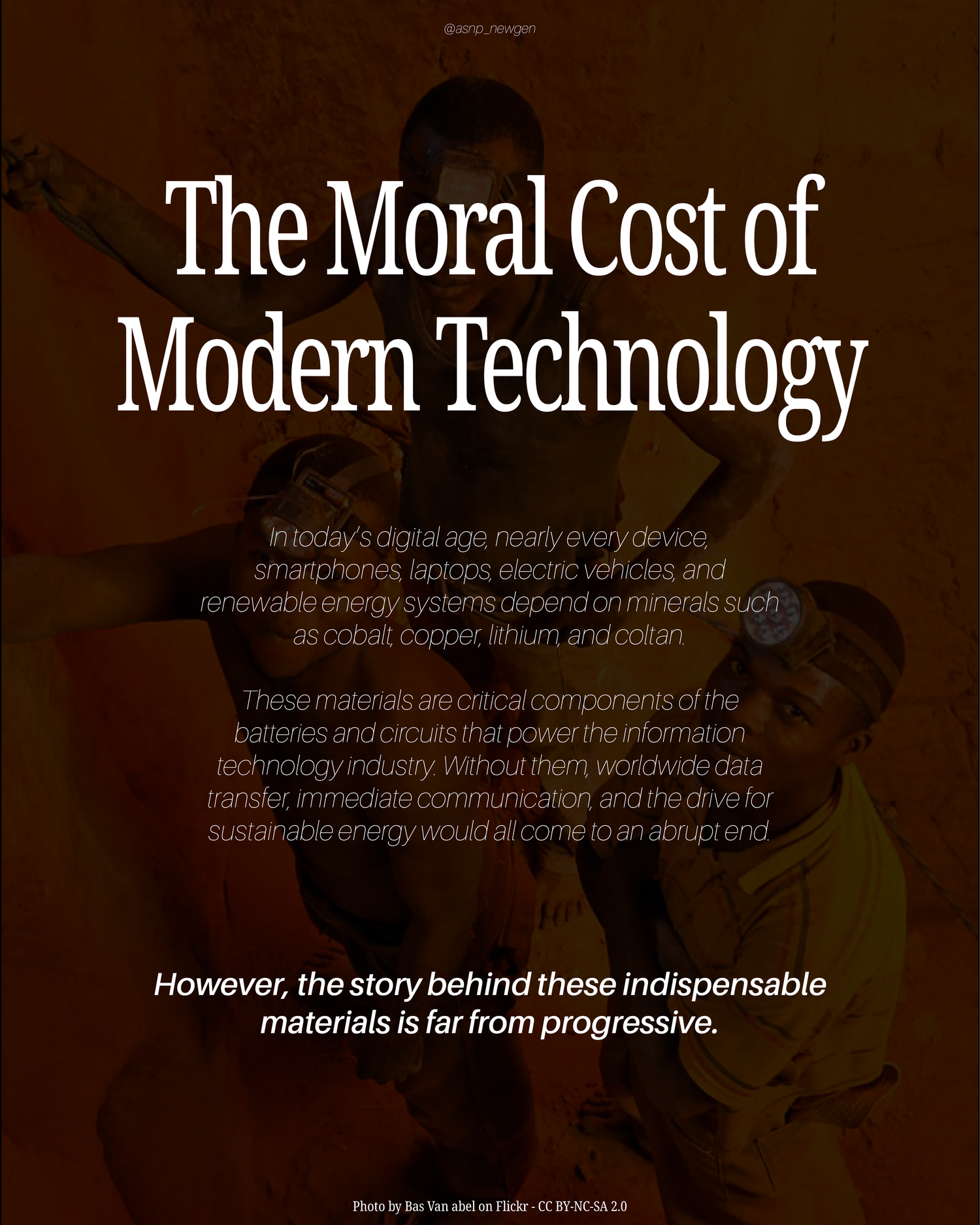
In today’s digital age, nearly every device—smartphones, laptops, electric vehicles, and renewable energy systems—depends on minerals such as cobalt, copper, lithium, and coltan. These materials are critical components of the batteries and circuits that power the information technology industry (Clemens). Without them, worldwide data transfer, immediate communication, and the drive for sustainable energy sources would all come to an abrupt end. Cobalt, in particular, plays an essential role in the production of batteries, which store energy efficiently and are prized for their durability and performance (Ewing). However, the story behind this indispensable material is far from progressive. More than 70% of the world’s cobalt originates in the Democratic Republic of the Congo (DRC), a nation rich in resources but drowned in poverty (Kgi-Admin). Beneath the wealthy surface of modern technology lies a troubling moral paradox: the very materials that make global connectivity possible are mined under conditions of human rights violations, environmental destruction, and systemic inequality (Amnesty International, “This Is What We Die For”).
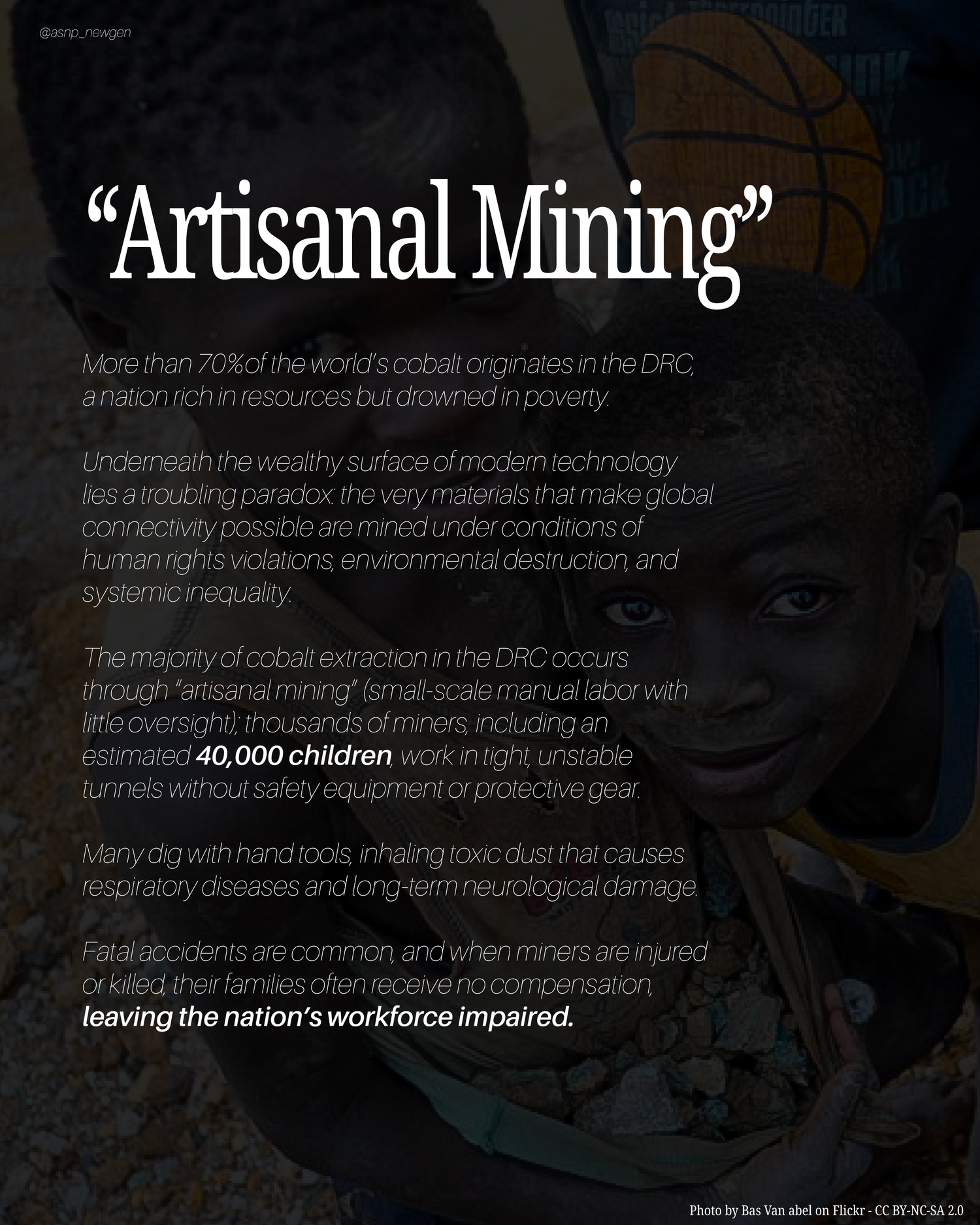
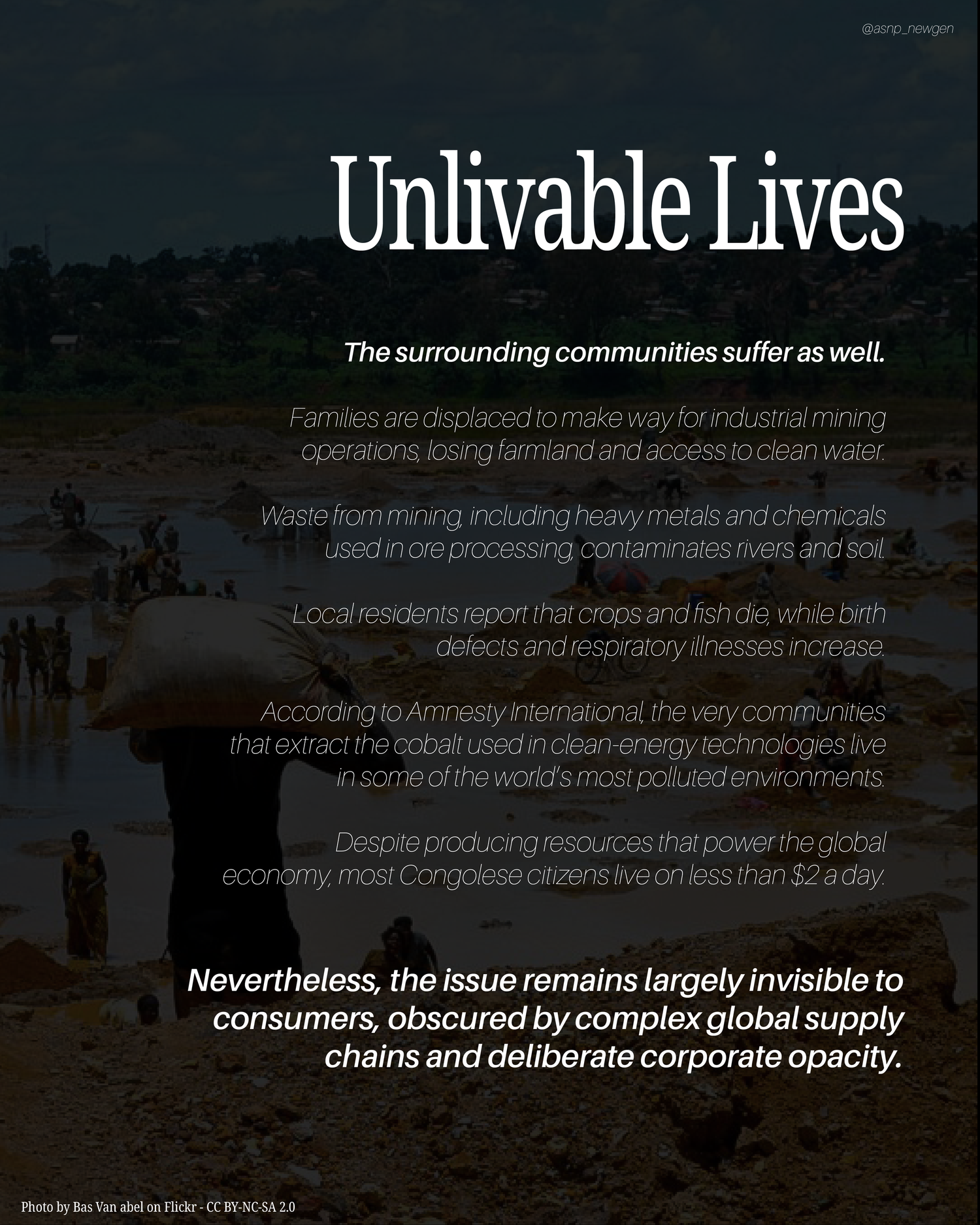
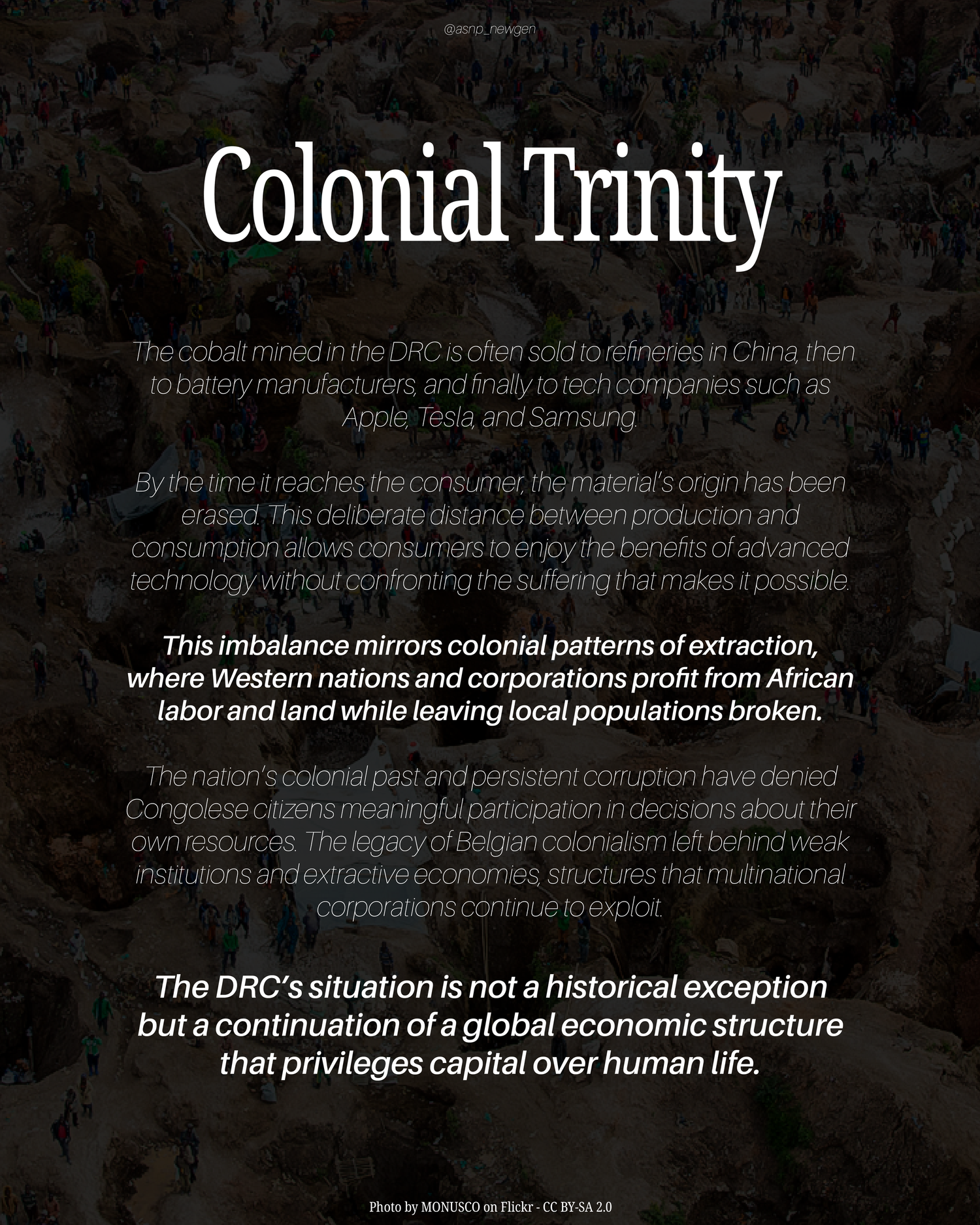
If these realities were widely publicized, the public response would likely mirror the outrage seen with other human rights scandals, calling for boycotts, corporate accountability, and ethical reforms. Nevertheless, the issue remains largely invisible to consumers, obscured by complex global supply chains and deliberate corporate opacity (Public Citizen’s Global Trade Watch, “The Deadly Cost of Cobalt Mining in the Congo”). The cobalt mined in the DRC is often sold to refineries in China, then to battery manufacturers, and finally to tech companies such as Apple, Tesla, and Samsung (World Bank, “Cobalt In The Democratic Republic Of Congo”). By the time it reaches the consumer, the material’s origin has been erased. This deliberate distance between production and consumption allows consumers to enjoy the benefits of advanced technology without confronting the suffering that makes it possible. The ethical dilemma at the heart of this issue is whether it is morally acceptable for Congolese communities, who endure displacement and exploitation, to receive such a minimal share in the wealth created from their own resources. This imbalance mirrors colonial patterns of extraction, where Western nations and corporations profit from African labor and land while leaving local populations broken (Friends of the Congo, “History Timeline”). The DRC’s situation is not a historical exception but a continuation of a global economic structure that privileges capital over human life (BBC News, “DR Congo Country Profile”). Cobalt mining directly affects the Congolese miners who perform the labor and the community that surrounds the mining sites. The majority of cobalt extraction in the DRC occurs through “artisanal mining”—in other words, small-scale manual labor with little oversight; thousands of miners, including an estimated 40,000 children, work in narrow, unstable tunnels without safety equipment or protective gear (Amnesty International, “Time to Recharge”). Many dig with hand tools, inhaling toxic dust that causes respiratory diseases and long-term neurological damage. Fatal accidents are common, and when miners are injured or killed, their families often receive no compensation, leaving the nation’s workforce impaired (Frankel). The surrounding communities suffer as well. Families are displaced to make way for industrial mining operations, losing farmland and access to clean water. Waste from mining, including heavy metals and chemicals used in ore processing, contaminates rivers and soil (Villegas). Local residents report that crops and fish die, while birth defects and respiratory illnesses increase. According to Amnesty International, the very communities that extract the cobalt used in clean-energy technologies live in some of the world’s most polluted environments (Amnesty International, “This Is What We Die For”). Despite producing resources that power the global economy, most Congolese citizens live on less than $2 a day (World Bank, “Cobalt In The Democratic Republic Of Congo - Market Analysis”).
The contradiction is overwhelming: the same mineral that enables electric vehicles and solar panels, symbols of environmental progress in wealthy nations, also creates ecological collapse and human suffering in the DRC (ABC News, “The Rush for Cobalt in the Congo Reveals the Human Cost of the World’s Green Energy Future”). Multinational corporations such as Glencore, CMOC Group, and Jinchuan Group, among others, profit immensely from low-cost cobalt extraction. Their annual revenues reach the billions, yet the workers at the beginning of the supply chain remain trapped in poverty (Briggs). These corporations face international criticism for their connections to child labor, unsafe conditions, and corruption (ISS Africa, “Rampant Cobalt Smuggling and Corruption Deny Billions to DRC”). In response, many have introduced corporate social responsibility initiatives, such as “conflict-free sourcing” certifications and community investment programs (Fair Cobalt Alliance, “Our Purpose”). However, these measures often serve as public relations tools rather than instruments of structural change (Amnesty International, “Time to Recharge”). CSR statements typically lack enforceable standards or oversight, allowing companies to market themselves as ethical without altering exploitative practices. When corporations claim to “inspect” supply chains, they often rely on self-reported data or inspections announced in advance, which conceal rather than reveal violations (Public Citizen’s Global Trade Watch, “The Deadly Cost of Cobalt Mining in the Congo”). The companies benefit economically but risk moral and reputational damage as advocacy groups, journalists, and filmmakers continue to expose the gap between wealth and equality. True accountability requires more than voluntary commitments. It demands legally binding frameworks that regulate international supply chains, enforce labor rights, and ensure equitable profit distribution (Kiezebrink and de Haan). Without such systems, corporate ethics will remain superficial, perpetuating the cycle of exploitation disguised as progress.
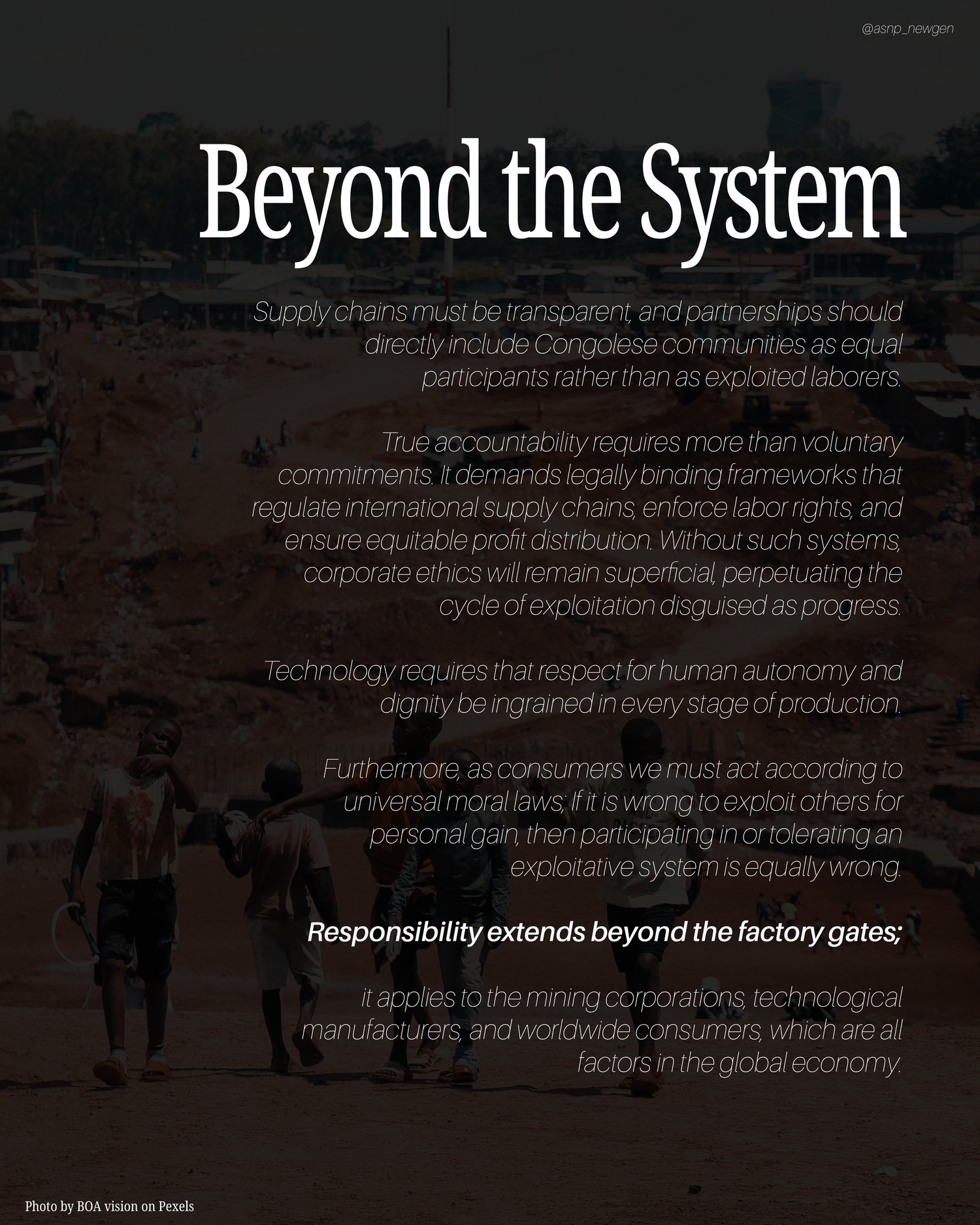
All human beings possess intrinsic worth and should be treated as ends in themselves. To reduce them to tools for economic gain is to deny their humanity. Applying this principle to the DRC, corporations and governments have a moral duty to ensure that miners work under fair contracts, with safety standards, living wages, and representation in decision-making processes (Amnesty International, “Time to Recharge”). Supply chains should be transparent, and partnerships should directly include Congolese communities as equal participants rather than as exploited laborers. Technology requires that respect for human autonomy and dignity be ingrained in every stage of production (Public Citizen’s Global Trade Watch, “The Deadly Cost of Cobalt Mining in the Congo”). Furthermore, consumers must be challenged to act according to universal moral laws. If it is wrong to exploit others for personal gain, then participating in or tolerating an exploitative system is equally wrong (Ewing). Ethical responsibility, therefore, extends beyond the factory gates; it applies to the mining corporations, technological manufacturers, and worldwide consumers, which are all factors in the global economy. We must evaluates each action by its capacity to produce the greatest happiness for the greatest number. On the surface, the global supply of cheap cobalt benefits billions of technology users: access to communication, education, and sustainable energy (IEA, “The Role of Critical Minerals in Clean Energy Transitions—Analysis”). Yet, these benefits are built on immense suffering. When all consequences are considered—poverty, health risks, displacement, and ecological collapse—the total harm far outweighs the collective good (Amnesty International, “This Is What We Die For”). The system must be restructured to increase overall well-being. This could include redistributing mining profits through fair-trade programs, investing in healthcare and education for mining communities, banning child labor, and enforcing safety regulations (World Bank, “Cobalt In The Democratic Republic Of Congo - Market Analysis”). Additionally, investing in alternative technologies, such as cobalt-free batteries or recycling programs, would reduce dependence on destructive mining practices (Clemens). By maximizing well-being across all affected parties, calling for systemic reform rather than incremental change, evaluating the morality of general rules rather than individual acts, offers a broader perspective. If the exploitation of workers were accepted as a universal rule, global economies would eventually face instability, resentment, and rebellion (Briggs). Inequality and injustice breed social unrest, undermining the very systems that sustain global trade. Therefore, a moral rule ensuring fair wages, regulated working conditions, and environmental protections would lead to greater collective well-being in the long run (Amnesty International, “Time to Recharge”). Governments and international organizations should collaborate to create mandatory global standards for mineral sourcing similar to the International Labour Organization’s conventions. Ethical certification programs for “conflict-free” or “responsibly sourced” minerals could reward companies that adhere to these standards, promoting justice and economic stability simultaneously (Fair Cobalt Alliance, “Our Purpose”).
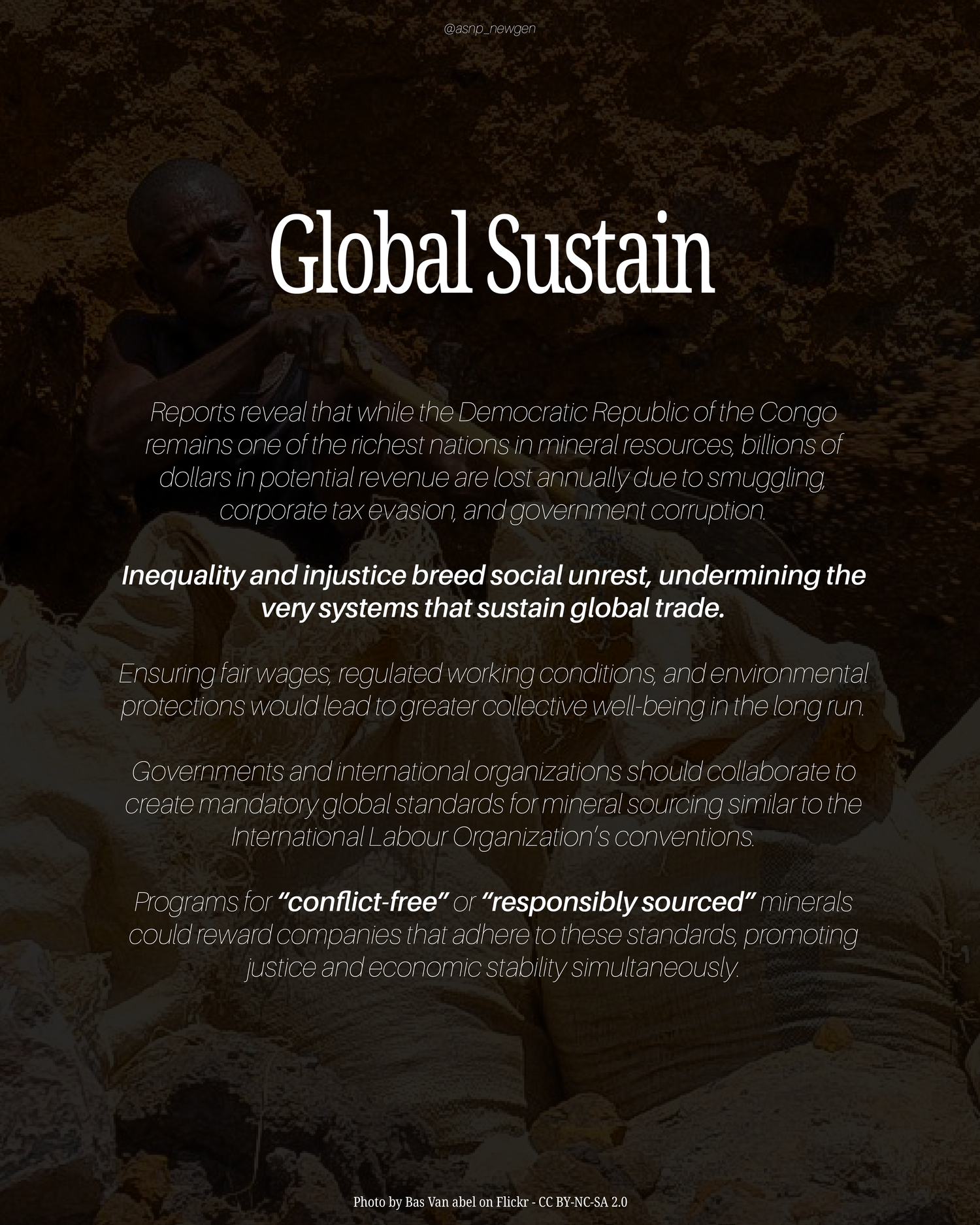
Mutual consent and fairness is the foundation of legitimate governance. In the DRC, however, the people have not consented to the conditions under which mining occurs. The nation’s colonial past and persistent corruption have denied Congolese citizens meaningful participation in decisions about their own resources. The legacy of Belgian colonialism left behind weak institutions and extractive economies, structures that multinational corporations continue to exploit (Friends of the Congo, “History Timeline”; BBC News, “DR Congo Country Profile”). This absence of legitimate consent violates the very principles of a fair social contract. Contemporary reports reveal that while the Democratic Republic of the Congo remains one of the richest nations in mineral resources, billions of dollars in potential revenue are lost annually due to smuggling, corporate tax evasion, and government corruption (ISS Africa, “Rampant Cobalt Smuggling and Corruption Deny Billions to DRC”; Al Jazeera, “Mining of Cobalt, Copper in DRC Leading to Human Rights Abuses: Report.”). These economic injustices reflect a systemic breach of the social contract, where citizens bear the environmental and social costs of extraction but receive none of its benefits (Villegas). Restoring moral legitimacy requires empowering the Congolese people to shape and enforce just institutions. Analysts argue that democratic oversight of mining revenues and greater transparency in government spending are necessary steps to combat corruption and ensure that resource wealth benefits local communities (World Bank, “Cobalt In The Democratic Republic Of Congo - Market Analysis”; Briggs). International monitoring could strengthen these reforms, providing accountability mechanisms that prevent abuse by both state and corporate actors (Amnesty International, Time to Recharge). Corporations, for their part, should be required to form equitable partnerships with local communities, ensuring that profits fund public goods such as schools, hospitals, and infrastructure. Initiatives like the Fair Cobalt Alliance have begun to promote more ethical and locally beneficial mining practices, but these efforts remain voluntary and small-scale without broader institutional reform (Fair Cobalt Alliance, “Our Purpose”; SOMO, “Cobalt Blues”). Only by rebuilding trust through transparency, inclusion, and justice can the DRC reestablish a fair social contract that honors the rights and dignity of its people.
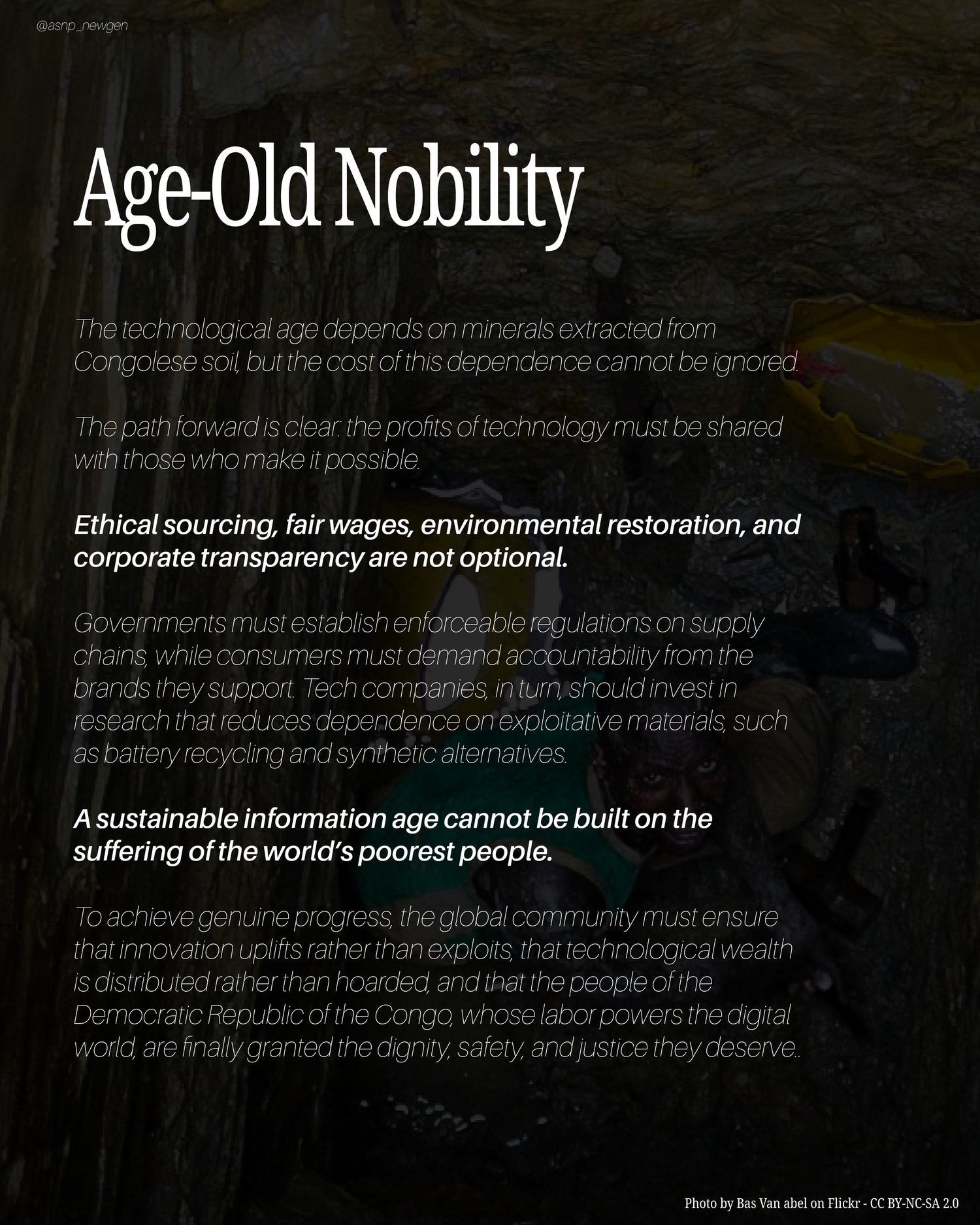
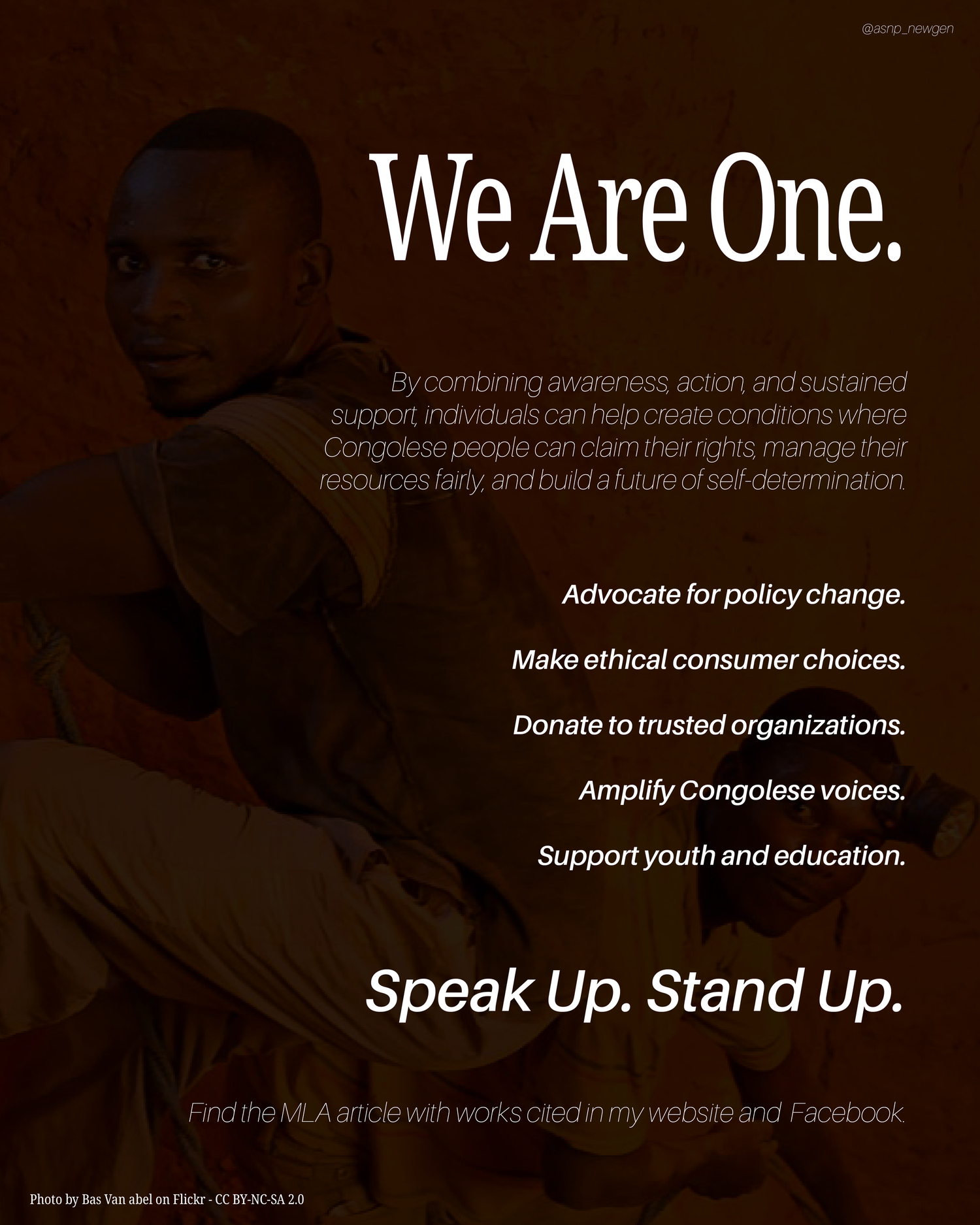
The technological age depends on minerals extracted from Congolese soil, but the ethical cost of this dependence cannot be ignored. The current system, which enriches corporations and consumers while impoverishing vulnerable communities, dehumanizes workers, it increases suffering, and lacks consent and justice. The moral path forward is clear: the profits of technology must be shared with those who make it possible. Ethical sourcing, fair wages, environmental restoration, and corporate transparency are not optional—they are moral imperatives. Governments must establish enforceable regulations on supply chains, while consumers must demand accountability from the brands they support. Tech companies, in turn, should invest in research that reduces dependence on exploitative materials, such as battery recycling and synthetic alternatives. A sustainable information age cannot be built on the suffering of the world’s poorest people. To achieve genuine progress, the global community must ensure that innovation uplifts rather than exploits, that technological wealth is distributed rather than hoarded, and that the people of the Democratic Republic of the Congo, whose labor powers the digital world, are finally granted the dignity, safety, and justice they deserve.
Works Cited:
Searcey, Dionne, et al. “A Power Struggle Over Cobalt Rattles the Clean Energy Revolution.” The NewYork Times, 7 Dec. 2021, www.nytimes.com/2021/11/20/world/china-congo-cobalt.html
De Haan, Esther, et al. “Cobalt Blues” SOMO. 1 Apr. 2016, www.somo.nl/nl/cobalt-blues.
Honorato, Felipe Antonio, and Pires de Freitas, Guilherme Silva. “Cobalt Exploration Is Vital for the Democratic Republic of Congo and the World” Africa at LSE, 9 Apr. 2024, blogs.lse.ac.uk/africaatlse/2024/04/04/cobalt-exploration-is-vital-for-the-democratic-republic-of-congo-and-the-world.
“Cobalt In The Democratic Republic Of Congo - Market Analysis.”, World Bank, June 2021, https://documents1.worldbank.org/curated/en/099500001312236438/pdf/P1723770a0f570093092050c1bddd6a29df.pdf
Frankel, Todd C. “Cobalt Mining for Lithium Ion Batteries Has a High Human Cost” The Washington Post, 30 Sept. 2016, www.washingtonpost.com/graphics/business/batteries/congo-cobalt-mining-for-lithium-ion-battery/.
Villegas, Eileen. “Cobalt Mining Is Ruining the Democratic Republic of Congo.” #ThinkLandscape, 15 Aug. 2025, thinklandscape.globallandscapesforum.org/73584/cobalt-mining-dr-congo-green-transition.
Kgi-Admin. “Cobalt Production in the Democratic Republic of the Congo and Major Projects.” Mining Technology, 23 Aug. 2024, www.mining-technology.com/data-insights/cobalt-in-the-democratic-republic-of-the-congo.
“Democratic Republic of the Congo: Time to Recharge: Corporate Action and Inaction to Tackle Abuses in the Cobalt Supply Chain” Amnesty International, 1 June 2021, www.amnesty.org/en/documents/afr62/7395/2017/en.
“Democratic Republic of Congo: ‘This Is What We Die for’: Human Rights Abuses in the Democratic Republic of the Congo Power the Global Trade in Cobalt” Amnesty International, 27 May 2025, www.amnesty.org/en/documents/afr62/3183/2016/en
“DR Congo Country Profile.” BBC News, 31 Jan. 2025, www.bbc.com/news/world-africa-13283212.
“History Timeline” Friends of the Congo, 8 May 2025, friendsofthecongo.org/history-timeline.
“Mining of Cobalt, Copper in DRC Leading to Human Rights Abuses: Report.” Al Jazeera, 12 Sept. 2023, www.aljazeera.com/news/2023/9/12/mining-of-cobalt-copper-in-drc-leading-to-human-rights-abuses-report.
“Rampant Cobalt Smuggling and Corruption Deny Billions to DRC” ISS Africa, issafrica.org/iss-today/rampant-cobalt-smuggling-and-corruption-deny-billions-to-drc.
“The Deadly Cost of Cobalt Mining in the Congo” Public Citizen’s Global Trade Watch, 11 July 2025, gtwaction.org/the-deadly-cost-of-cobalt-mining-in-the-congo.
“Our Purpose” The Fair Cobalt Alliance, 4 Feb. 2025, faircobaltalliance.org.
“The Role of Critical Minerals in Clean Energy Transitions–Analysis” IEA, 5 May 2021, www.iea.org/reports/the-role-of-critical-minerals-in-clean-energy-transitions.
“The Rush for Cobalt in the Congo Reveals the Human Cost of the World’s Green Energy Future.” ABC News, 5 Sept. 2022, www.abc.net.au/news/2022-02-24/cobalt-mining-in-the-congo-green-energy/100802588.
Clemens, Kevin. “Understanding the Role of Cobalt in Batteries” DesignNews, 16 Feb. 2023, www.designnews.com/electronics/understanding-the-role-of-cobalt-in-batteries.
Ewing, Samantha M. “U.S. Geological Survey, Mineral Commodity Summaries” US GOV. Jan. 2023, pubs.usgs.gov/periodicals/mcs2024/mcs2024-cobalt.pdf.