
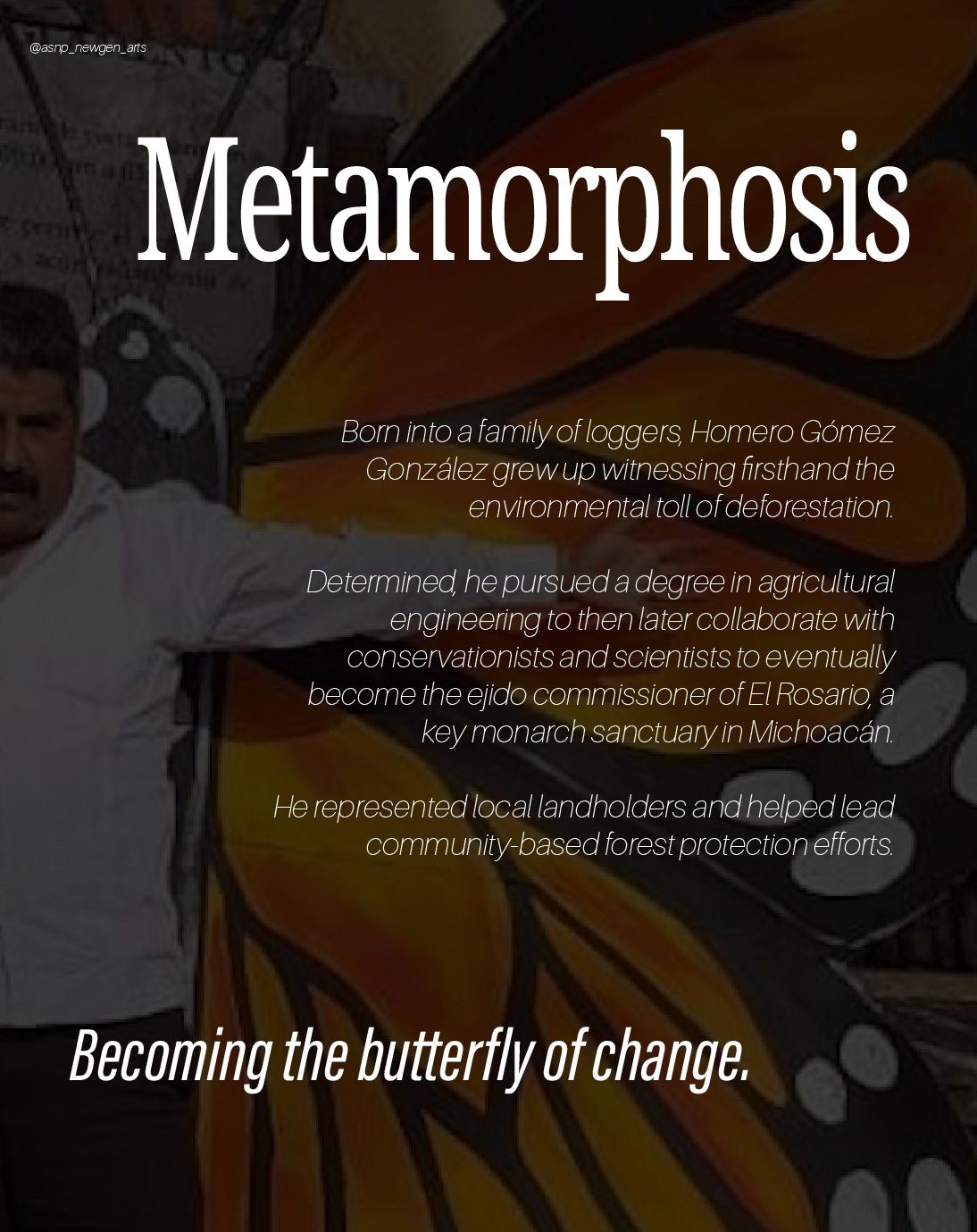
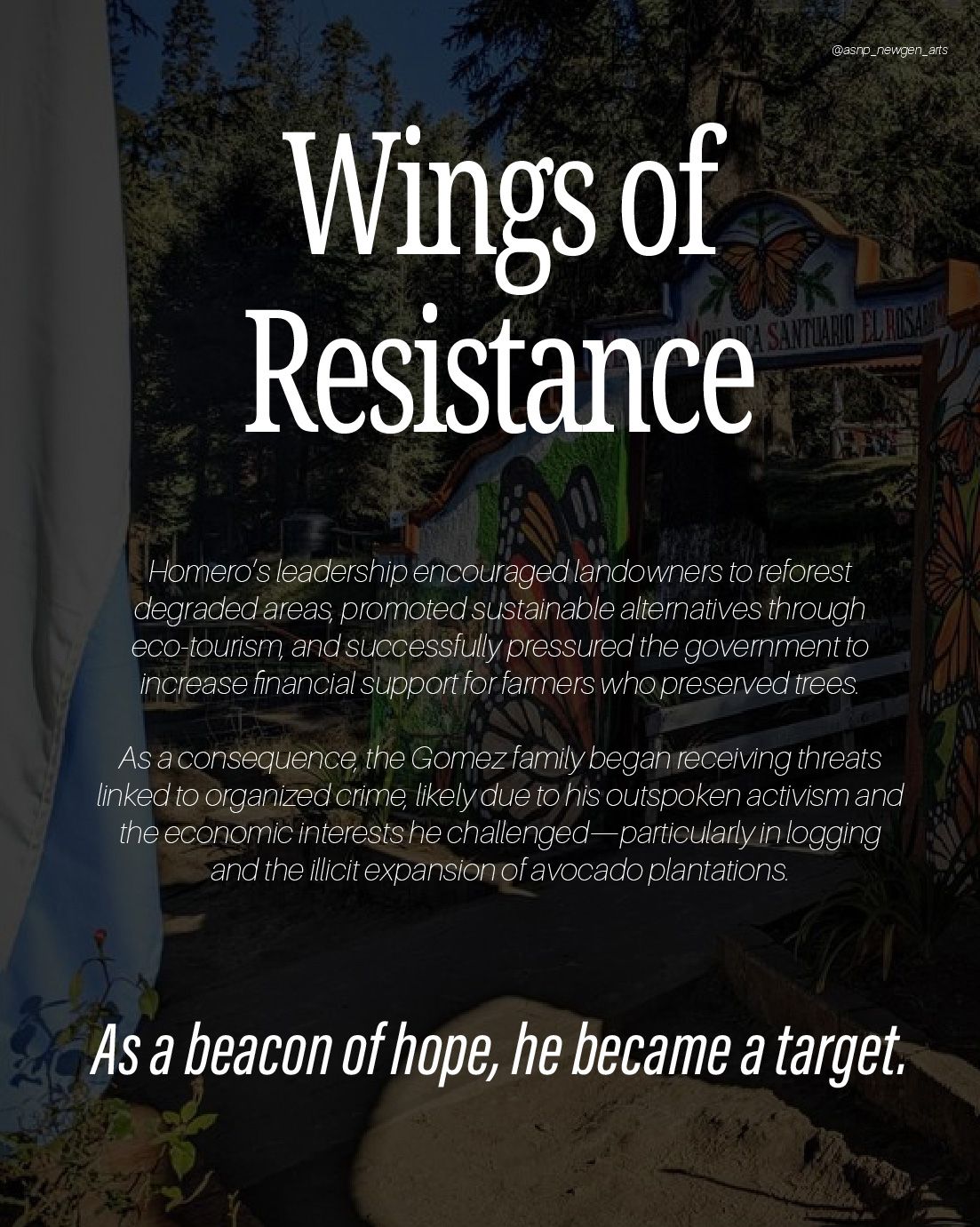
Born into a family of loggers, Homero Gómez González grew up witnessing firsthand the environmental toll of deforestation. Determined to mold a different path, he pursued a degree in agricultural engineering. His education opened the door to alternative approaches, and he became a passionate advocate for ecotourism as a way to both protect the forests and support local livelihoods. Homero collaborated with conservationists and scientists, including those from the World Wildlife Fund (WWF) and the Monarch Butterfly Biosphere Reserve, and eventually became the ejido commissioner of El Rosario, a key monarch sanctuary in Michoacán. In this role, he represented local landholders and helped lead community-based forest protection efforts. His leadership played a major role in organizing local opposition to illegal logging and resisting pressure from criminal groups involved in unauthorized avocado cultivation—a major driver of deforestation in the region. He also encouraged landowners to reforest degraded areas, promoted sustainable alternatives through eco-tourism, and successfully pressured the government to increase support for farmers who preserved forest cover.
Before his disappearance in 2020, Homero’s family reported receiving threats linked to organized crime, likely due to his outspoken activism and the economic interests he challenged—particularly in logging and the illicit expansion of avocado plantations.
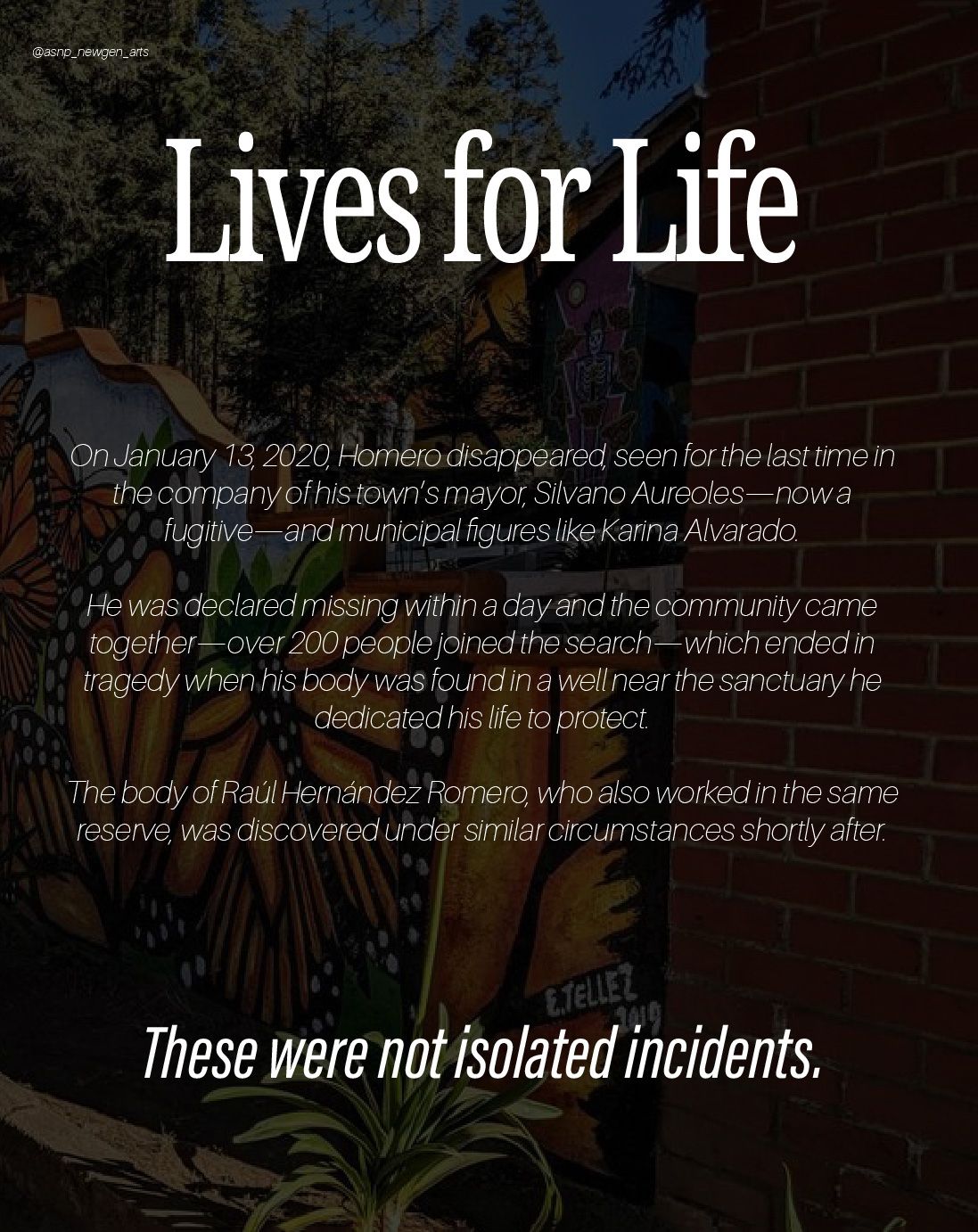
On January 13th, 2020, at the age of 50, Homero disappeared. The last time he was seen, he was reportedly in the company of his town’s mayor, Silvano Aureoles—now a fugitive—and municipal figures like Karina Alvarado, Octavio Ocampo, and one of Karina’s assistants. Within less than a day, he was declared missing. According to his family, they had already been receiving threatening phone calls before Homero vanished—and those calls continued afterward. Some of the callers claimed responsibility for his kidnapping and demanded ransom.
The community came together—over 200 people joined the search—but it ended in tragedy. Nearly two weeks later, his body was found floating in a well near the sanctuary he dedicated his life to protecting. Shortly after, the body of fellow activist Raúl Hernández Romero, who also worked in the same reserve, was discovered under similar circumstances. Yet, Mexico’s National Commission of Protected Natural Areas (CONANP) denied any connection between their deaths and their activism—and, unbelievably, wouldn’t even confirm whether the two cases were related.
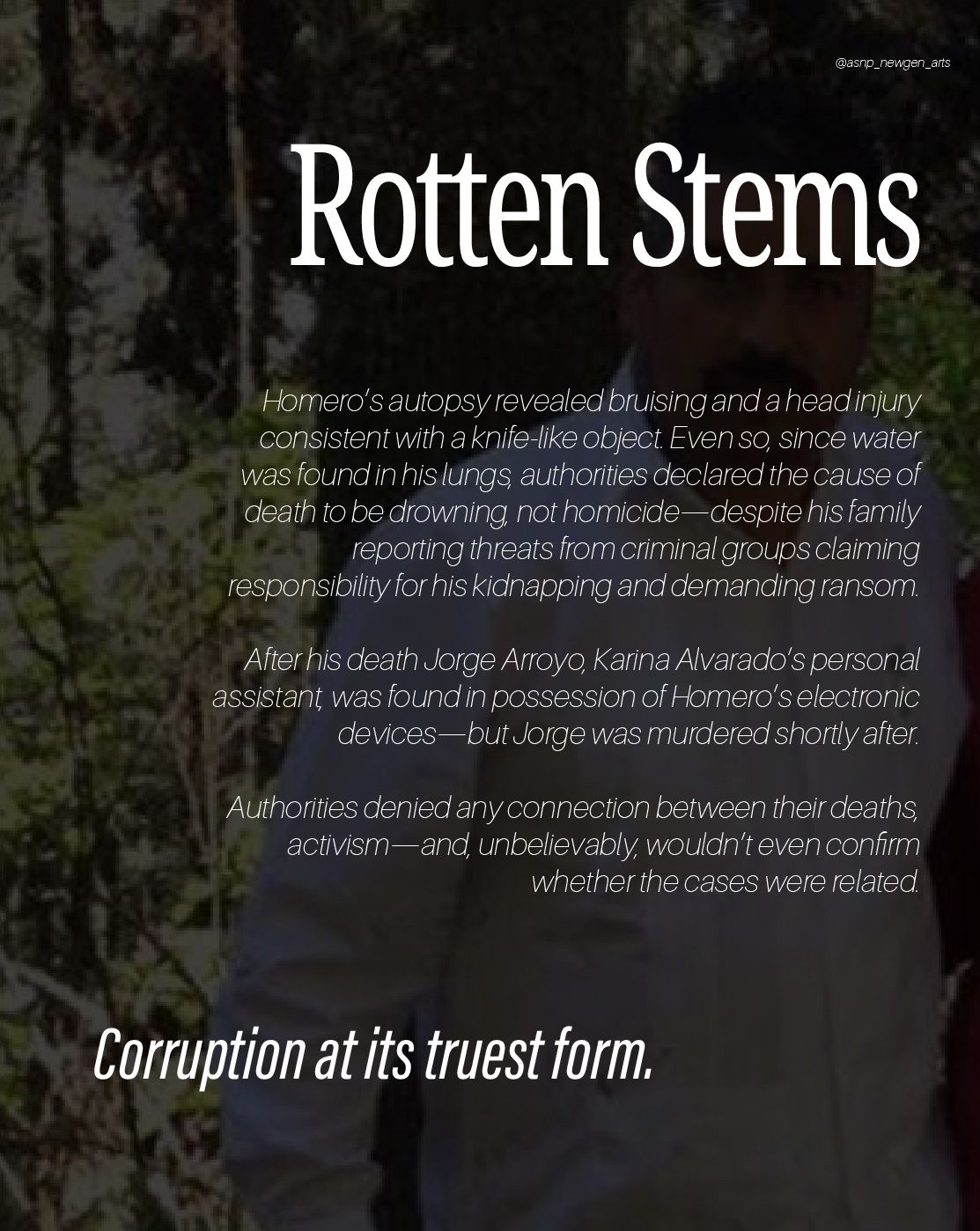
Robbery was quickly ruled out as a motive—when Homero’s body was found, he still had nearly 10,000 pesos in cash (about $500 USD) on him. As the investigation began, local police were questioned and even detained. According to reports, Karina Alvarado allegedly arranged a meeting on January 13th—the day Homero disappeared. In the days leading up to that meeting, members of the PRD (Party of the Democratic Revolution) had reportedly been trying persistently to track him down. One of the most disturbing findings came later: Jorge Arroyo, Karina Alvarado’s personal assistant, was found in possession of Homero’s electronic devices after his death—but not long after, Jorge was murdered.
At first glance, there were no visible signs of violence on Homero’s body. But the autopsy revealed bruising and a head injury consistent with a knife-like object. Even so, since water was found in his lungs, authorities declared the cause of death to be drowning, not homicide—despite his family reporting threats from criminal groups tied to illegal logging and fruit export in the area. In the weeks following his disappearance, Homero’s wife publicly claimed that both Karina Alvarado and Octavio Ocampo filed for constitutional injunctions (amparos)—a legal move to shield themselves from the investigation. Karina has since spoken out, denying the accusations.
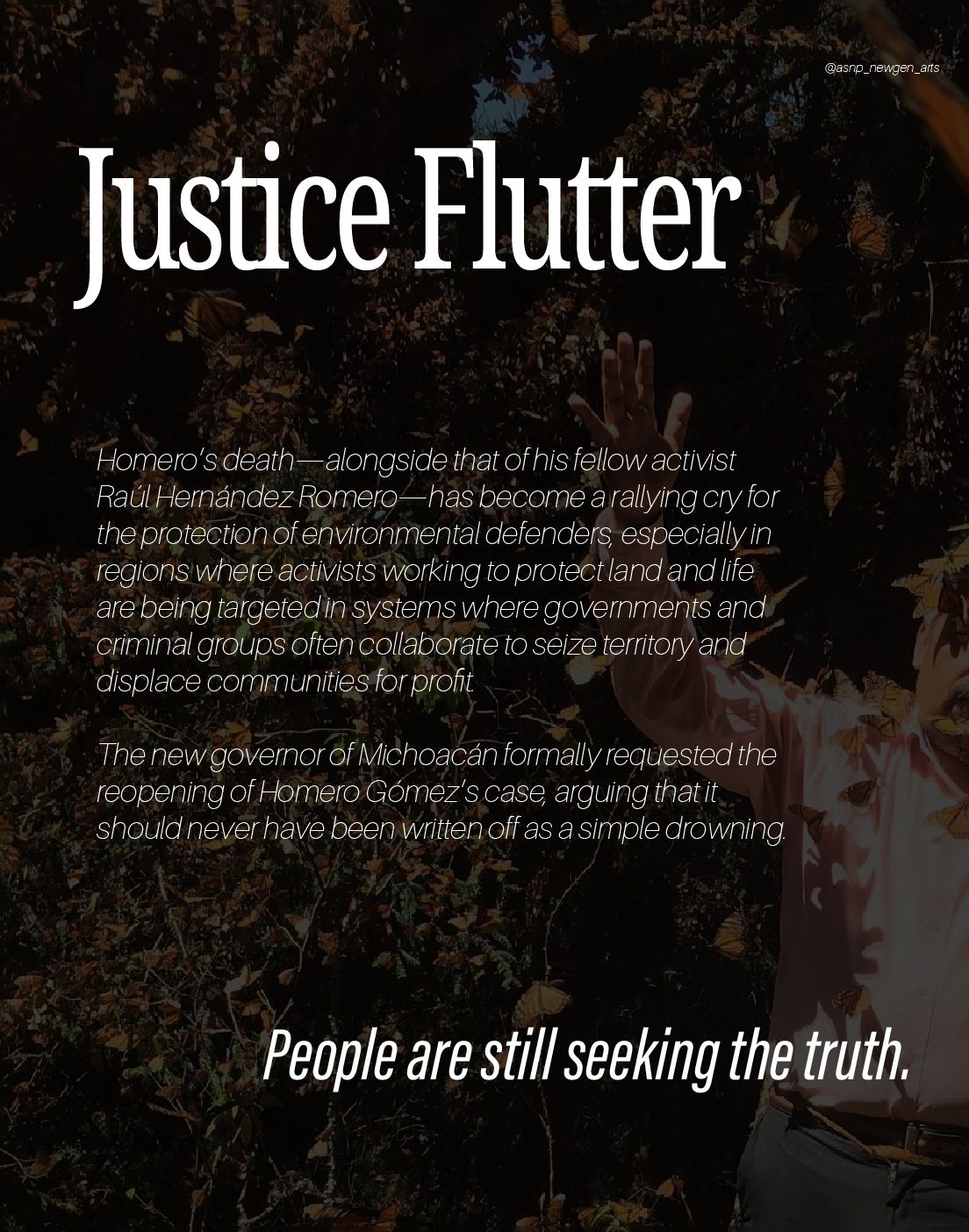
Government officials, including a former Mexican president and state governor, publicly expressed hope of finding Homero alive—and later, shared their sorrow when news of his death was confirmed. UNESCO (United Nations Educational, Scientific and Cultural Organization) also voiced sadness and concern, calling for a deeper investigation into what happened. Artists across Mexico and beyond have responded with grief, channeling their outrage and mourning into murals, poems, songs, and visual art. Homero’s death—alongside that of his fellow activist Raúl Hernández Romero—has become a rallying cry for the protection of environmental defenders, especially in regions where activism puts people in direct conflict with organized crime and corrupt state powers.
Millions around the world have raised their voices, pointing to a pattern: activists working to protect land and life are being targeted in systems where governments and criminal groups often collaborate to seize territory and displace communities for profit. In 2024, the new governor of Michoacán formally requested the reopening of Homero Gómez’s case, arguing that it should never have been written off as a simple drowning. He demanded answers about the head injuries revealed in the autopsy—details the original investigation had largely ignored.
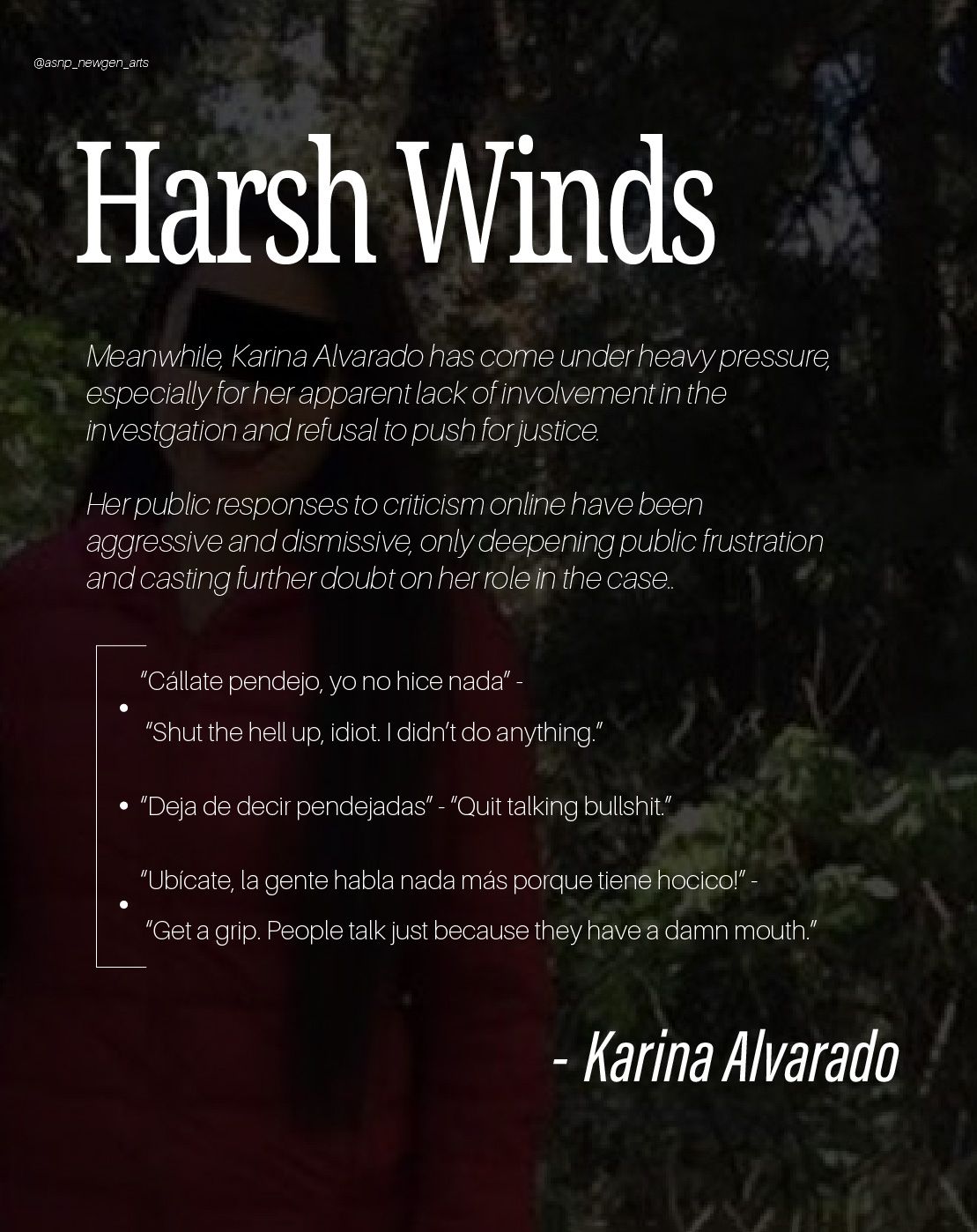
Meanwhile, Karina Alvarado has come under heavy scrutiny, especially for her apparent lack of involvement in pushing for justice. Her public responses to criticism online have been aggressive and dismissive, including comments like:
- “Cállate pendejo, yo no hice nada” - “Shut the hell up, idiot. I didn’t do anything.”
- “Deja de decir pendejadas” - “Quit talking bullshit.”
- “¡Ubícate, la gente habla nada más porque tiene hocico!” - “Get a grip. People talk just because they have a damn mouth.”
These remarks have only deepened public frustration and cast further doubt on her role in the case.
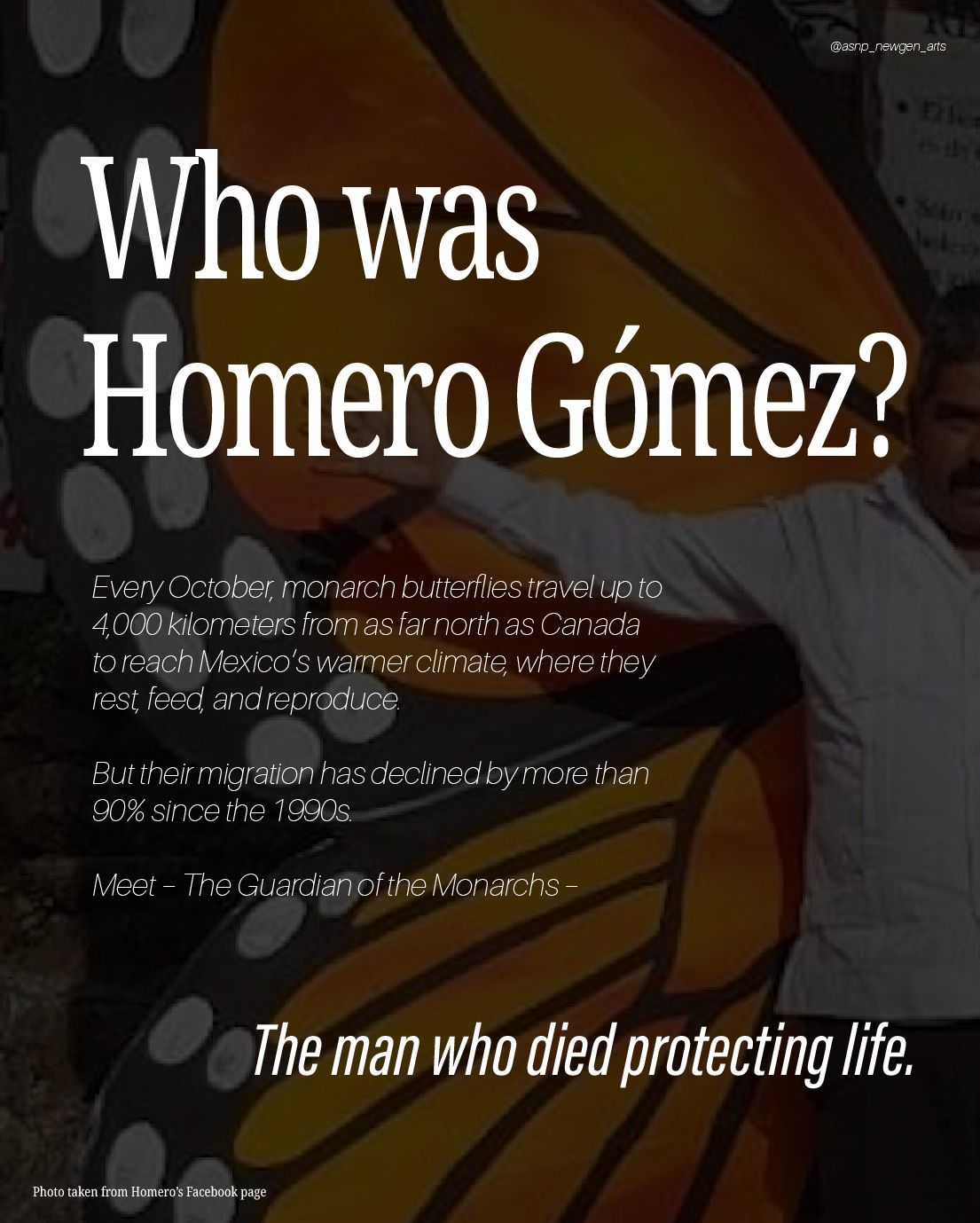
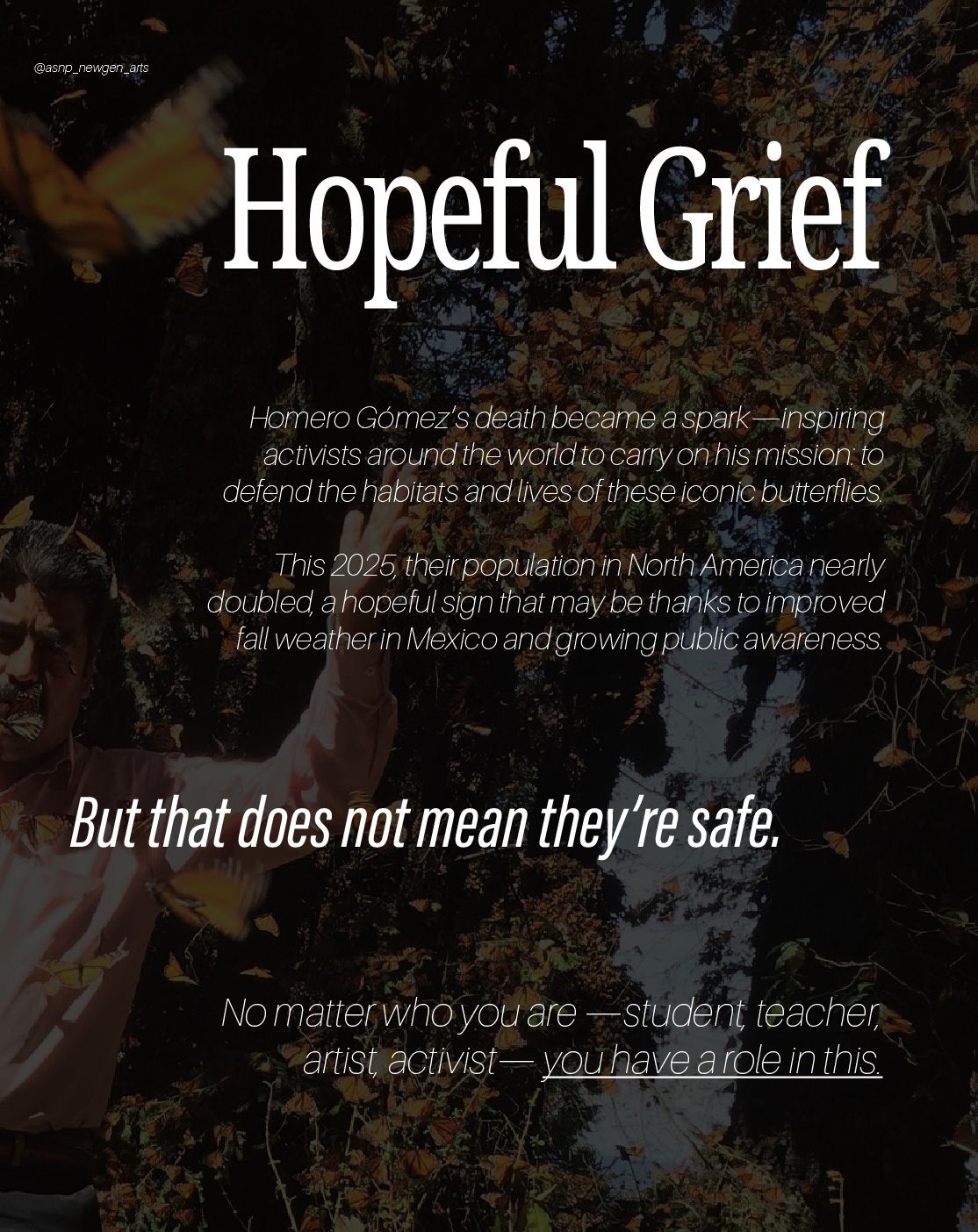
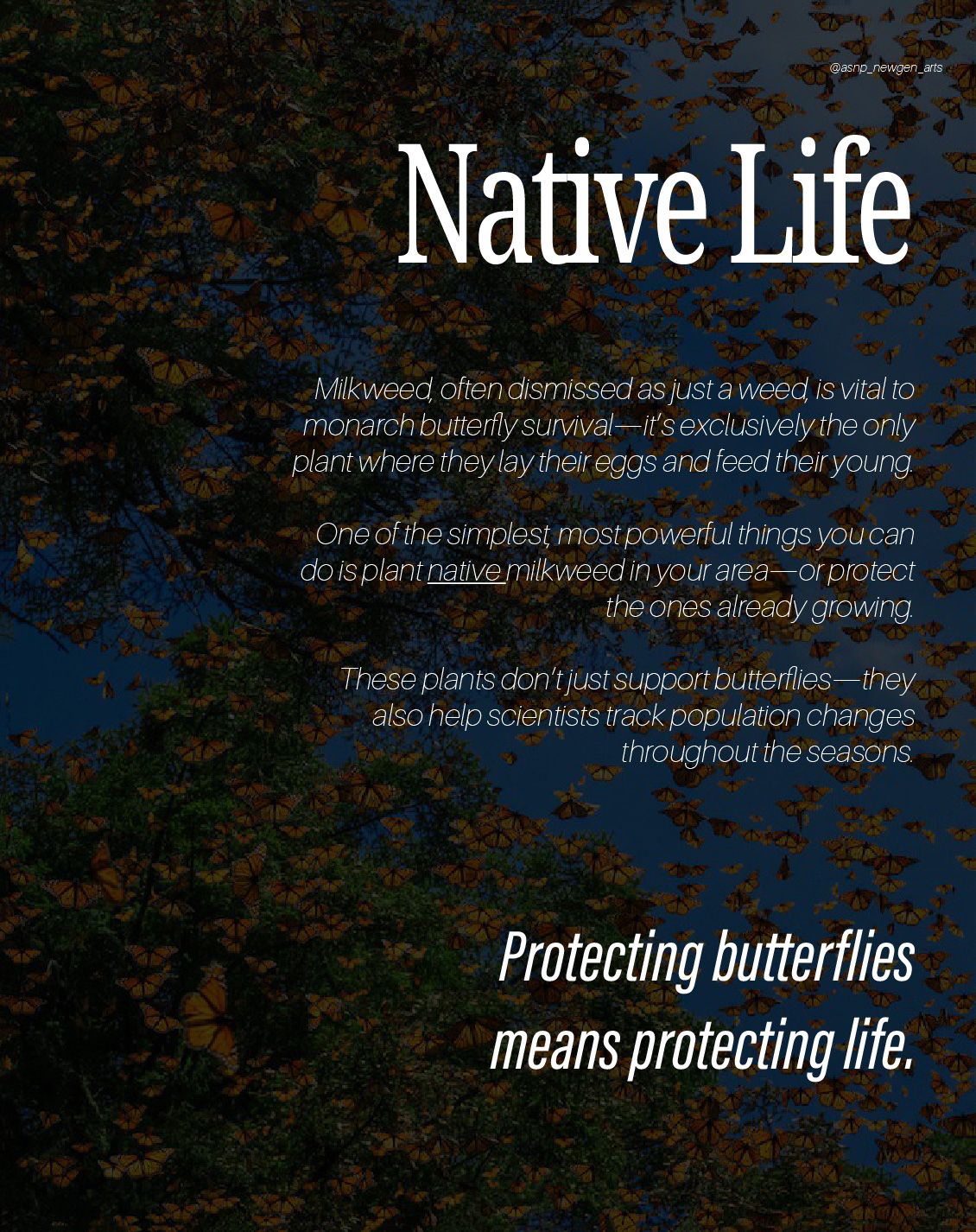
Every October, monarch butterflies begin an epic journey—traveling up to 4,000 kilometers from as far north as Canada to reach Mexico’s warmer climate, where they rest, feed, and reproduce. But their migration has declined by more than 90% since the 1990s. Homero Gómez’s death became a spark—inspiring activists around the world to carry on his mission: to defend the habitats and lives of these iconic butterflies. This year, their population in North America nearly doubled, a hopeful sign that may be thanks to improved fall weather in Mexico and growing public awareness. But that doesn’t mean they’re safe. Pesticides, climate change, and habitat destruction still threaten their survival every day. And you can help change that; Milkweed, often dismissed as just a weed, is vital to monarch butterfly survival—it’s the only plant where they lay their eggs and feed their young. But this essential plant is being wiped out by pesticides and land development.
One of the simplest, most powerful things you can do is plant native milkweed in your area—or protect the ones already growing. These plants don’t just support butterflies—they also help scientists track population changes throughout the seasons.
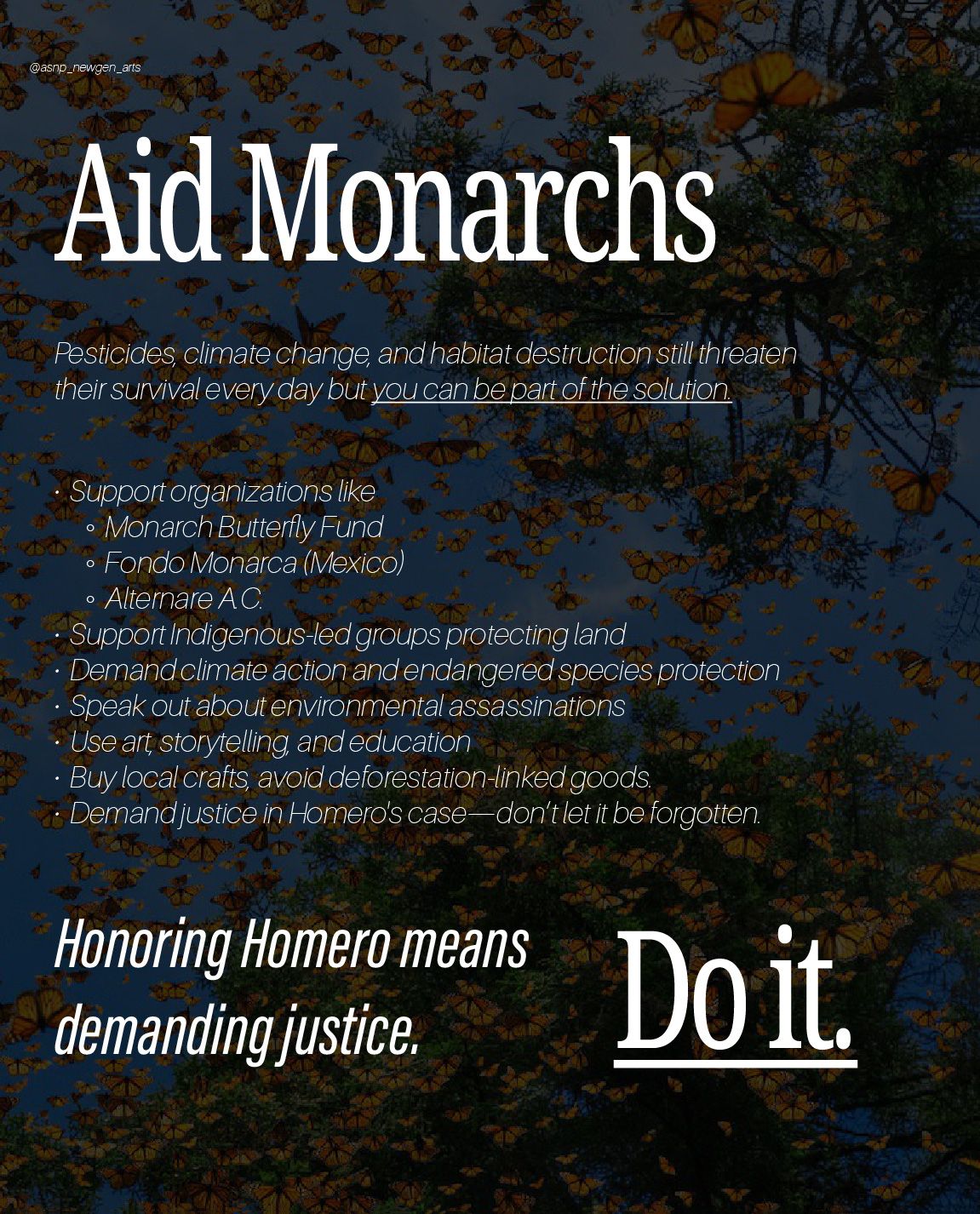
You can also help by donating to or volunteering with organizations dedicated to protecting monarchs and their habitats. This is how we keep Homero Gómez’s legacy alive. Below, I’ve listed some trustworthy groups doing real work on the ground:
- Monarch Butterfly Fund: monarchconservation.org
- Fondo Monarca (Mexico): community-based conservation
- Alternare AC: works directly with ejidos near the El Rosario sanctuary
And let’s not forget the ejidos; indigenous communal lands and the communities defending them daily from criminal industries and government neglect. They need our support. Learn their history. Say their names.
Back the groups that protect them:
- Centro Prodh (legal aid & human rights)
- Global Witness
- Front Line Defenders
There are so many ways to help:
Use art, film, and storytelling to raise awareness. Host local milkweed plantings or “Monarch Days”. Advocate for monarchs to be listed as endangered at state and federal levels. Demand climate action—migration depends on stable weather patterns. Demand transparency and justice in Homero’s case. Pressure lawmakers to: Protect ejido lands. Fund sustainable ecotourism over extraction. Enforce deforestation bans with real consequences.
If you visit the sanctuaries in Michoacán, support community-run sites like El Rosario. Buy local crafts, not mass-made souvenirs. Avoid timber and avocado products tied to deforestation unless they’re certified sustainable or directly community-sourced. Honoring Homero Gómez González is more than remembrance—it’s a call to action.
Protecting the monarch butterflies is protecting our shared future.
Whether you’re a student, artist, educator, activist, or policymaker: you have a role.
Do it.
References:
https://en.wikipedia.org/wiki/Homero_G%C3%B3mez_Gonz%C3%A1lez?utm_source=chatgpt.com
https://en.wikipedia.org/wiki/Ejido
https://www.commondreams.org/news/2020/01/30/outpouring-grief-after-missing-mexican-monarch-butterfly-defender-homero-gomez
https://globalearthrepairfoundation.org/homero-gomez-gonzalez/?utm_source=chatgpt.com
https://www.wuwm.com/environment/2025-07-17/monarch-butterfly-population-rebounds-but-its-still-one-of-the-lowest-numbers-on-record?utm_source=chatgpt.com
https://en.wikipedia.org/wiki/Monarch_Butterfly_Biosphere_Reserve?utm_source=chatgpt.com
https://mexicodailypost.news/2024/05/17/the-guardian-of-the-monarchs-governor-of-michoacan-asks-to-reopen-the-case-of-the-death-of-environmentalist-homero-gomez/?utm_source=chatgpt.com
https://decider.com/2024/05/14/homero-gomez-gonzalez-guardian-of-the-monarchs-netflix-documentary-review/?utm_source=chatgpt.com
https://www.dailyclimate.org/monarch-conservationists-tragic-disappearance-shines-a-light-on-environmental-dangers-in-mexico-2669372838.html?utm_source=chatgpt.com
https://hrdmemorial.org/hrdrecord/homero-gomez-gonzalez/?utm_source=chatgpt.com
https://abcnews.go.com/International/double-murder-mystery-linked-mexicos-famed-monarch-butterfly/story?id=68746901&utm_source=chatgpt.com
https://www.infobae.com/mexico/2024/05/15/que-paso-con-homero-gomez-regidora-karina-alvarado-insulta-y-restringe-comentarios-en-sus-redes-tras-documental-de-netflix/